12922 Briarwest Cir
Houston, TX 77077
Phone
(713) 737-5529
info@actualseomedia.com



Keyword stuffing refers to the excessive and unnatural repetition of search terms within web content, meta tags, or hidden text. It’s an attempt to game search algorithms.
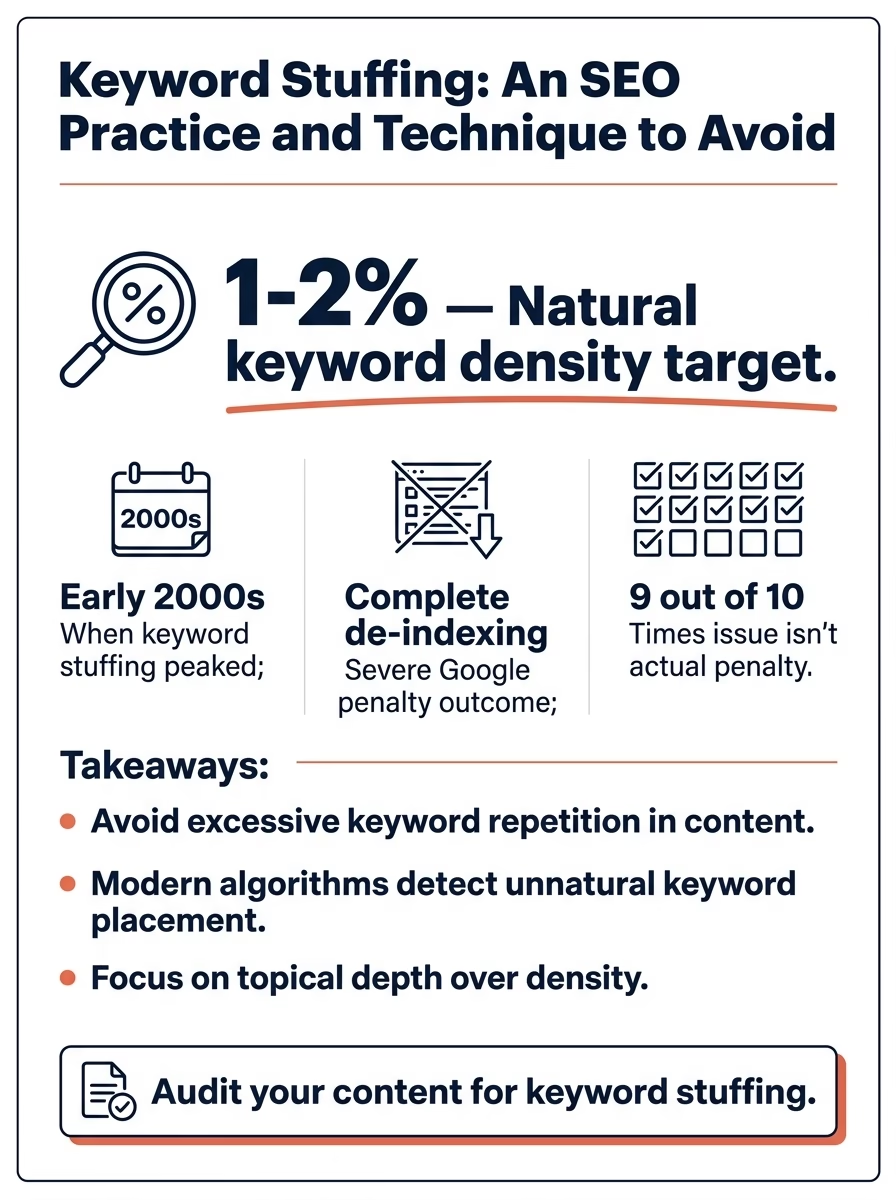
This tactic peaked in the early 2000s, when search engines relied heavily on simple keyword density calculations. Site owners would cram phrases like “Houston plumber” dozens of times into a single page. It worked. Briefly. Then Google’s algorithm updates caught up.
According to Google’s spam policies, keyword stuffing violates their guidelines and can result in ranking penalties or complete de-indexing. Yet we still see it today. Why?
Many site owners don’t realize the practice is harmful. They struggle to find current guidance. They’ve heard “use keywords” but missed the memo on natural integration. Others rely on outdated SEO tools that recommend absurd density targets like 5% or higher. I once audited an 8,000-page site where the single biggest ranking drag was orphan pages nobody had linked to in years, but a close secondary drag was pages so stuffed with keywords they read like spam.
Here’s the reality: keyword stuffing died around 2013. Topical depth is what moves rankings now.
Modern search algorithms use natural language processing and semantic analysis to detect unnatural keyword repetition. They can tell when you’re writing for humans versus robots.
Google’s systems evaluate context, synonym usage, and readability to find issues. If your content reads like it was written for a robot, Google’s helpful-content system treats it like one. The algorithm looks for red flags: unnatural phrasing, repetitive anchor text, invisible text blocks, and abnormal keyword density. All of these signal a lack of genuine human-focused content.
Penalties range from subtle to severe. A page might drop from position 5 to position 50. Or the entire domain might vanish from search results. The good news? Manual review teams at Google can remove penalties once you fix the problem. The bad news? Recovery takes months. You’ll lose traffic the whole time.
I’ve seen the damage firsthand. Nine times out of ten, the “Google penalty” a client fears is just thin, duplicated service-area pages competing with each other. But when keyword stuffing is the culprit, the fix requires a complete content rewrite.
Let’s get specific. Here are the most common forms we encounter during site audits:
Each of these triggers algorithmic flags. And they destroy user experience, which is itself a ranking signal.
There’s no magic number. Aim for natural, contextually appropriate usage, typically between 0.5% and 2% density.
That means in a 1,000-word article, your primary keyword might appear 5 to 20 times. But counting is the wrong approach. Instead, write for clarity and comprehensiveness. Use synonyms, related phrases, and variations. Google understands them.
For example, if you’re targeting “keyword stuffing,” you can also use “overusing keywords,” “keyword abuse,” or “excessive keyword repetition.” The algorithm connects those dots. You don’t need to repeat the exact phrase endlessly.
At Actual SEO Media Inc., we’ve worked with dozens of Houston-area businesses to optimize their content. On a Katy client’s site, fixing internal silo structure moved them from page 3 to the top of the map pack in about nine weeks. We didn’t add more keywords. We added better structure and context.
Most SEO platforms, like Yoast, Surfer SEO, and Clearscope, calculate density automatically. But don’t obsess over the number. Read your content aloud. If it sounds robotic, you’ve overdone it.
We recommend a simple test: would you read this article if you weren’t paid to? If the answer is no, rewrite it.
Focus on user intent first, keywords second. Your goal is to answer the searcher’s question completely and clearly.
Start with a content brief. Identify the core topic, the questions users ask, and the subtopics that support comprehension. Then write naturally. Weave your target keyword into headings, the opening paragraph, and a few subheadings, but only where it fits.
Use variations and long-tail phrases. If your keyword is “Houston SEO,” you might also include “search engine optimization in Houston,” “SEO services near me,” or “Houston digital marketing.” Google treats these as related.
Here are four concrete tactics we use at Actual SEO Media Inc.:
One statistic drives this home: according to research from Backlinko, the average first-page result on Google contains approximately 1,447 words. Length alone won’t rank you, but comprehensive, naturally optimized content will.
Beyond immediate penalties, keyword stuffing erodes trust with your audience. Visitors bounce. Conversion rates plummet. Your brand reputation suffers.
Search engines track user behavior. High bounce rates and low dwell time signal poor content quality. Over time, Google downranks pages that fail to satisfy searchers, even if they’re not technically penalized for spam.
Recovery is expensive. You’ll need to rewrite content, build new backlinks, and wait for Google to re-crawl and re-index your pages. Most “SEO emergencies” we get called about turn out to be a botched migration that dropped 301 redirects, but keyword-stuffing cleanup runs a close second in terms of time and cost.
Here’s the part most people miss: even after you fix the content, you have to rebuild trust with Google. That means consistent publishing, earning quality backlinks, and demonstrating E-E-A-T (Experience, Expertise, Authoritativeness, Trustworthiness). It’s a months-long process.
Yes, but it requires a complete content overhaul. Identify every page flagged for stuffing. Rewrite them with natural phrasing. Submit a reconsideration request if you’ve received a manual action notice in Google Search Console.
Automated penalties usually lift once the algorithm re-crawls your improved content. Manual penalties require human review and can take weeks.
Start with a solid content strategy. Map out user intent for each keyword, then build content that satisfies that intent fully.
Use semantic SEO principles. Google’s algorithm understands related concepts, so you can rank for dozens of variations of a keyword by covering the topic comprehensively. For example, an article about “keyword stuffing” might also rank for “SEO spam,” “overoptimization,” and “Google penalties” without repeating those exact phrases constantly.
Invest in quality over quantity. One well-researched, 2,000-word guide will outperform ten shallow 300-word posts. At Actual SEO Media Inc., we’ve seen this pattern repeat across industries, from law firms in the Galleria to HVAC companies in Pearland.
Use structured data and schema markup. This helps search engines understand your content’s context without relying on keyword repetition. Rich snippets, FAQ schema, and How-To markup all improve visibility while keeping your content readable.
Finally, test and iterate. Monitor rankings, traffic, and engagement metrics. If a page underperforms, refine the content, but resist the urge to just add more keywords. Look at topical gaps, readability issues, and user intent mismatches instead.
Keyword stuffing is the practice of overloading web content with target keywords in an unnatural way to manipulate search rankings. It includes visible repetition, hidden text, and excessive use of keywords in meta tags or alt attributes. Google penalizes this behavior because it creates a poor user experience and violates spam policies. Modern SEO prioritizes natural language, topical depth, and comprehensive coverage over keyword density.
Google uses natural language processing and machine learning algorithms to identify unnatural keyword patterns. The system evaluates readability, context, synonym usage, and user engagement signals like bounce rate and dwell time. If content reads unnaturally or contains repetitive phrasing, the algorithm flags it. Manual review teams can also issue penalties for severe cases. Recovery requires rewriting flagged content and sometimes submitting a reconsideration request.
There’s no universal safe percentage, but most experts recommend keeping keyword density between 0.5% and 2%. However, focusing on a specific number misses the point. Write naturally for your audience. Use synonyms and related phrases. Ensure your content fully answers the searcher’s question. Reading your content aloud is a better test than any density calculation. If it sounds robotic, you’ve overdone it.
Keyword stuffing can cause severe ranking drops and even de-indexing, but the damage isn’t always permanent. If you rewrite the affected content and remove unnatural keyword usage, perhaps identified with a keyword stuffing checker, Google’s algorithm will eventually re-evaluate your pages. This often involves removing a clear keyword stuffing example of overused terms. Manual penalties require a reconsideration request and human review. Recovery typically takes several months, and you’ll lose traffic during that period. Prevention is far easier than recovery, so always prioritize natural, user-focused content from the start.
Keyword stuffing can cause severe ranking drops and even de-indexing, but the damage isn’t always permanent. If you rewrite the affected content and remove unnatural keyword usage, Google’s algorithm will eventually re-evaluate your pages. Manual penalties require a reconsideration request and human review. Recovery typically takes several months, and you’ll lose traffic during that period. Prevention is far easier than recovery, so always prioritize natural, user-focused content from the start.


12922 Briarwest Cir
Houston, TX 77077
Phone
(713) 737-5529
info@actualseomedia.com
19901 Southwest Fwy #310
Sugar Land, TX 77479
Phone (281) 962-6166
sugarland@actualseomedia.com
24044 Cinco Village Center Blvd #100
Katy, TX 77494
Phone (281) 962-7777
katy@actualseomedia.com
1880 S Dairy Ashford Rd Suite 682
Houston, TX 77077
Phone (346) 946-9494
seo@actualseomedia.com
2800 Post Oak Blvd Suite 4100
Houston, TX 77056
Phone (832) 390-2407
williamstower@actualseomedia.com
10210 Grogans Mill Rd Suite 230,
The Woodlands, TX 77380
Phone (713)
201-7666
thewoodlands@actualseomedia.com
16310 Texas 249 Access Rd Suite 1303, Houston, TX 77064
Phone (832) 834-0661
tomball@actualseomedia.com
| Day | Hours |
|---|---|
| Sunday | 8:00 AM- 8:00 PM |
| Monday | 8:00 AM—8:00 PM |
| Tuesday | 8:00 AM—8:00 PM |
| Wednesday | 8:00 AM—8:00 PM |
| Thursday | 8:00 AM—8:00 PM |
| Friday | 8:00 AM—8:00 PM |
| Saturday | 8:00 AM—8:00 PM |
