12922 Briarwest Cir
Houston, TX 77077
Phone
(713) 737-5529
info@actualseomedia.com



Keyword research means figuring out the specific words and phrases people type into Google when they’re hunting for information, products, or services. It matters because search engines exist to match queries with relevant content. If you don’t know what your audience is searching for, you can’t show up.
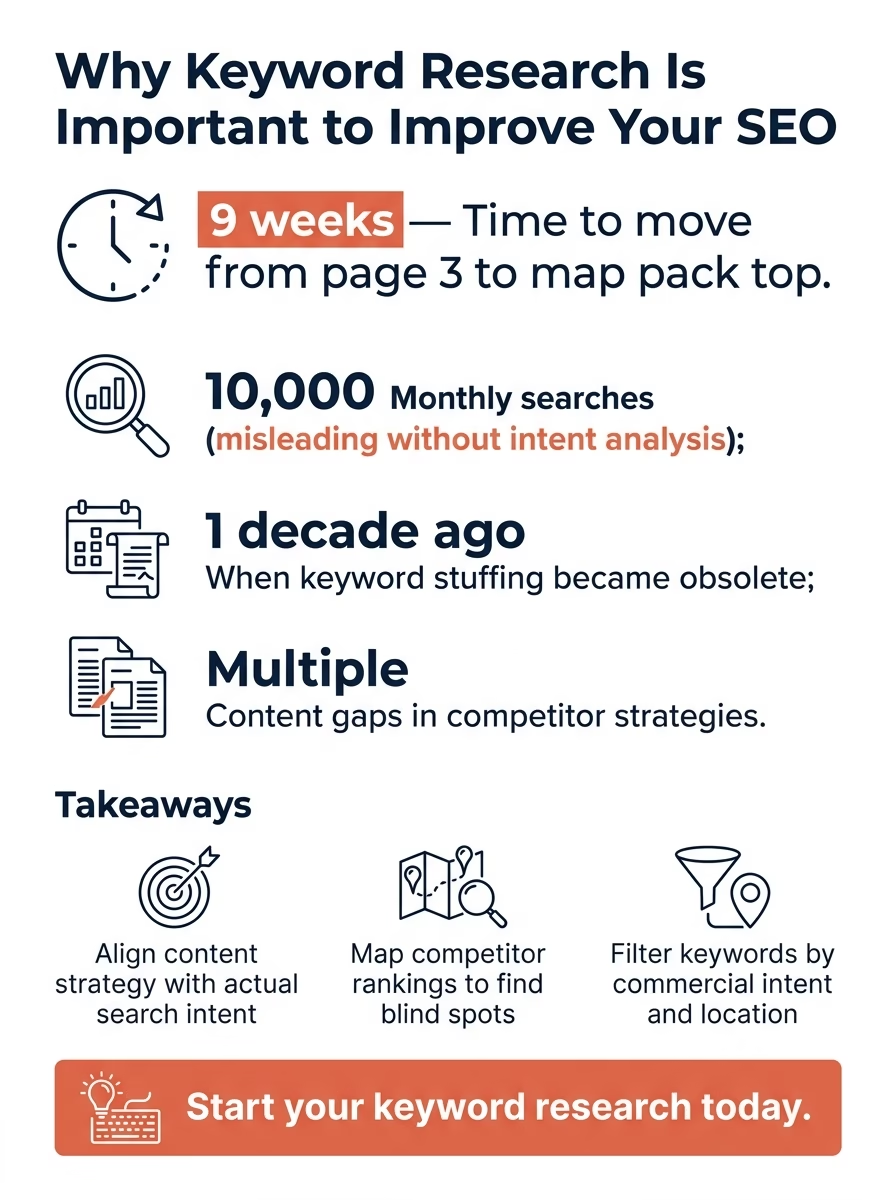
According to GeeksforGeeks, keyword research helps you understand user intent, discover content gaps, and optimize topics for the highest return on investment. I’ve watched this play out dozens of times. On a Katy client’s site back in 2022, we reorganized their internal silo structure around properly researched keywords. They jumped from page 3 to the top of the map pack in nine weeks.
Too many businesses create content based on what they think is important. Not what their customers actually search for. That disconnect wastes time and budget.
Every search query signals intent. Someone typing “emergency plumber near me” has a different need than someone searching “how to fix a leaky faucet.” Keyword research decodes those signals. You deliver the right content at the right stage of the buyer journey.
When you dig into search data, you’ll uncover the exact language your audience uses. Often it’s wildly different from industry jargon. Your competitors might write about “HVAC system optimization,” but real customers search “why is my AC bill so high.” That gap? That’s your opportunity.
Here’s what most people miss. Keyword research isn’t just about volume. A term with 10,000 monthly searches sounds appealing, but if 9,000 of those searchers want free information and you sell a service, you’ve targeted the wrong crowd. We use keyword research tools to filter by commercial intent, location, and seasonality. This is critical when ranking in Sugar Land requires a different strategy than ranking in the Heights. Competition density isn’t even close between those two markets. This process guides your entire strategy.
Your competitors already rank for something. Keyword research shows you what they rank for, how strong their content is, and where gaps exist that you can exploit.
When we audit a client’s competitive set, we don’t just look at their homepage. We map every piece of content they’ve published. The keywords driving traffic to each page. The backlink profile supporting those rankings. Often we find a competitor dominates one cluster of terms but ignores adjacent topics entirely. Those blind spots? Pure gold.
Keyword stuffing died in 2012. Topical depth is what moves rankings now. If you want to outrank an established player, you need a content strategy built on comprehensive keyword mapping. Not just the obvious head terms. The long-tail variations and question-based queries that real users ask. Professional SEO services can accelerate this process by layering competitive intelligence with search demand data.
Don’t guess. Measure.
Not every keyword is a battleground. Smart research uncovers terms with decent search volume but lower competition. Often local modifiers, specific product names, or emerging trends your competitors haven’t noticed yet.
For a Houston-based law firm in 2023, we identified a cluster of neighborhood-level injury terms like “car accident lawyer Cypress TX” that larger firms had overlooked. They were chasing citywide keywords. Those hyper-local terms converted at nearly double the rate and cost a fraction of the effort to rank.
Search intent is the “why” behind the query. Google’s algorithms have become incredibly sophisticated at distinguishing informational intent (“how to change a tire”) from transactional intent (“buy run-flat tires near me”). If your content doesn’t match the intent, you won’t rank. Even if you use the keyword fifty times.
There are four primary intent types. Informational, navigational, commercial investigation, and transactional. Keyword research tools help you classify terms by intent so you can tailor content format and tone accordingly. A blog post answering “why keyword research is important” satisfies informational intent. A service page with pricing and a contact form satisfies transactional intent.
I once audited an 8,000-page site where the single biggest ranking drag was orphan pages nobody had linked to in years. Pages that targeted the right keywords but sat disconnected from the site’s topical clusters. Proper research doesn’t stop at keyword selection. It informs site architecture, internal linking, and content planning.
You can’t write about everything at once. Keyword research gives you a priority list based on search volume, competition, business relevance, and current rankings.
Start with quick wins. Terms where you already rank on page two or three. A bit of on-page optimization and a few internal links can push those into the top ten fast. Then target gap keywords: high-value terms your competitors rank for but you don’t. Finally, invest in pillar content around head terms that anchor entire topic clusters.
At Actual SEO Media Inc, we build content calendars directly from keyword matrices. Each article targets a primary keyword, two to three semantic variations, and a set of related questions pulled from “People Also Ask” boxes. That structure ensures every piece of content pulls its weight.
Keyword research isn’t one-and-done. Search trends shift. Competitors launch new content. Your own site’s authority grows, unlocking access to more competitive terms.
We track keyword rankings monthly, compare them to traffic and conversion data, and adjust the content roadmap quarterly. If a keyword drops, we investigate. Did Google update its algorithm? Did a competitor publish something better? Is the page still technically sound?
Professional keyword research combines multiple data sources. Google Keyword Planner for search volume. Ahrefs or SEMrush for competition metrics. Answer the Public for question-based queries. Google Search Console for terms you already rank for.
Here’s a condensed workflow. Start with seed keywords, broad terms that describe your business. Expand those into hundreds of variations using a keyword tool. Filter by search volume, keyword difficulty, and cost-per-click (a proxy for commercial value). Group related terms into topic clusters. Map each cluster to a content type: blog post, service page, FAQ, video.
Then validate. Are people actually searching this way? Check Google’s autocomplete suggestions and “People Also Ask” boxes. If your keyword doesn’t show up naturally in these features, rethink it.
Chasing volume alone is the biggest mistake. A keyword with 50,000 monthly searches sounds great until you realize it’s dominated by Wikipedia, government sites, and brands with domain authority in the triple digits.
Another trap? Ignoring location modifiers if you’re a local business. “SEO services” is brutally competitive and vague. “SEO services Houston” narrows the field and attracts customers who can actually hire you. I’ve watched businesses waste six months targeting national terms when their service area was a 20-mile radius.
And don’t forget this. If your content reads like it was written for a robot, Google’s helpful-content system treats it like one. Natural integration beats forced repetition every single time.
The main purpose of keyword research is to identify the exact terms and phrases your target audience uses when searching for products, services, or information related to your business. This data informs content creation, site structure, and optimization priorities so you can rank for queries that drive qualified traffic and conversions. Without it, you’re guessing what matters to both users and search engines.
You should revisit keyword research at least quarterly, or whenever you plan new content campaigns, launch products, or notice ranking fluctuations. Search trends evolve. Competitors publish new content. Your site’s authority grows over time. All of which open up new keyword opportunities. Monthly tracking of existing keyword performance helps you spot shifts early and adjust strategy before rankings drop.
Yes, you can conduct basic keyword research using free tools like Google Keyword Planner, Google Trends, Answer the Public, and your own Google Search Console data. These tools provide search volume estimates, related queries, and performance insights for terms you already rank for. However, paid tools like Ahrefs, SEMrush, or Moz offer deeper competitive analysis, keyword difficulty scores, and more comprehensive data that save time and improve decision-making for serious SEO efforts.
Short-tail keywords are broad, one to two-word phrases like “SEO” or “plumber Houston” that have high search volume but intense competition and vague intent. Long-tail keywords are longer, more specific phrases like “why keyword research is important for local SEO” that have lower search volume but higher conversion rates because they match precise user intent. Long-tail terms are often easier to rank for and attract visitors closer to making a decision, making them valuable for most businesses.
Keyword research is how you discover what people actually search for when they’re looking for information, products, or services online. You dig into those search terms to see how many people hunt for them each month, how many other websites are competing for those same words, and whether they match what you’re offering. Get this part right and you’re setting up your entire SEO strategy on solid ground. Without understanding what your audience is typing into Google, you’re essentially guessing. You might create great content that nobody’s actually searching for. Or chase keywords so competitive that ranking for them would take years. The real power of keyword research is that it bridges the gap between what you want to talk about and what people actually want to find.
Short-tail keywords are broad, one to two-word phrases like “SEO” or “plumber Houston” that have high search volume but intense competition and vague intent. Long-tail keywords are longer, more specific phrases like “why keyword research is important for local SEO” that have lower search volume but higher conversion rates because they match precise user intent. Long-tail terms are often easier to rank for and attract visitors closer to making a decision, making them valuable for most businesses.
Keyword research is how you discover what people actually search for when they’re looking for information, products, or services online. You dig into those search terms to see how many people hunt for them each month, how many other websites are competing for those same words, and whether they match what you’re offering. Get this part right and you’re setting up your entire SEO strategy on solid ground. Without understanding what your audience is typing into Google, you’re essentially guessing. You might create great content that nobody’s actually searching for, or chase keywords so competitive that ranking for them would take years. The real power of keyword research is that it bridges the gap between what you want to talk about and what people actually want to find.


12922 Briarwest Cir
Houston, TX 77077
Phone
(713) 737-5529
info@actualseomedia.com
19901 Southwest Fwy #310
Sugar Land, TX 77479
Phone (281) 962-6166
sugarland@actualseomedia.com
24044 Cinco Village Center Blvd #100
Katy, TX 77494
Phone (281) 962-7777
katy@actualseomedia.com
1880 S Dairy Ashford Rd Suite 682
Houston, TX 77077
Phone (346) 946-9494
seo@actualseomedia.com
2800 Post Oak Blvd Suite 4100
Houston, TX 77056
Phone (832) 390-2407
williamstower@actualseomedia.com
10210 Grogans Mill Rd Suite 230,
The Woodlands, TX 77380
Phone (713)
201-7666
thewoodlands@actualseomedia.com
16310 Texas 249 Access Rd Suite 1303, Houston, TX 77064
Phone (832) 834-0661
tomball@actualseomedia.com
| Day | Hours |
|---|---|
| Sunday | 8:00 AM- 8:00 PM |
| Monday | 8:00 AM—8:00 PM |
| Tuesday | 8:00 AM—8:00 PM |
| Wednesday | 8:00 AM—8:00 PM |
| Thursday | 8:00 AM—8:00 PM |
| Friday | 8:00 AM—8:00 PM |
| Saturday | 8:00 AM—8:00 PM |
